The Turtle May Move Slowly, But...
A Slow-Moving Problem Is Getting Closer
I’m not sure what keeps drawing turtles to our house. Maybe it’s the pool!
The other day, the girls spotted one on the patio. They went outside, snapped a few pictures, turned around, and Mr. Turtle was gone.
For something that moves so slowly, he sure disappeared quickly. In some ways, that reminds me of the dilemma facing Social Security.
The problems facing the program haven’t appeared overnight. They’ve been slowly developing for decades, and we have a pretty good understanding of what got us here.
But much like Mr. Turtle, something that moves slowly can still sneak up on you.
For years, the possibility of Social Security benefit reductions seemed like a problem way off in the distance. Now, we’re potentially only a handful of years away from the program being unable to pay 100 percent of scheduled retirement and survivor benefits unless Congress acts.
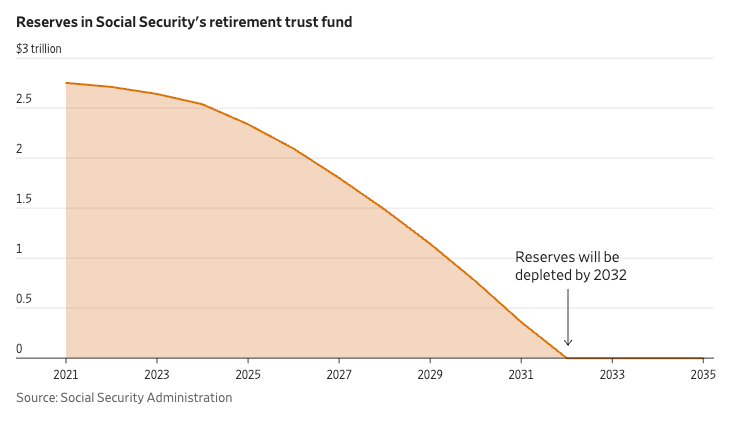
According to the 2026 Social Security Trustees Report, the Old-Age and Survivors Insurance (OASI) Trust Fund is projected to be depleted in the fourth quarter of 2032.
If that happened and Congress made no changes, continuing program income would be sufficient to pay approximately 78% of scheduled benefits.
In other words, we're talking about a potential 22% shortfall in scheduled benefits, not because Social Security disappears, but because the money coming into the program would no longer be enough to pay everything promised under current law.
The turtle may move slowly, but that doesn’t mean you can ignore where it’s headed.
Congress Is Starting to Pay Attention
The good news is that lawmakers appear to be paying more attention to the issue.
A recent Wall Street Journal article reported that members of both parties are beginning to discuss possible solutions. The article made an important point: the longer Congress waits, the more difficult the eventual solution becomes.
West Virginia Senator Jim Justice expressed confidence that Congress ultimately won't allow Social Security to hit that wall, saying he believes funding will be found because lawmakers simply can't allow it to happen.
I hope he’s right.
But where does the additional money come from?
That's where things get complicated.
Raise Taxes, Reduce Benefits or Find Another Source?
One frequently discussed proposal is increasing the amount of wages subject to Social Security payroll taxes.
For 2026, employees pay 6.2 percent in Social Security tax on wages up to $184,500, and employers pay another 6.2 percent. Self-employed workers generally pay the combined 12.4 percent rate.
Earnings above $184,500 aren't currently subject to the Social Security portion of the payroll tax.
That makes raising or eliminating the taxable wage cap an obvious target when lawmakers discuss ways to bring more money into the system.
But there are tradeoffs.
Higher-income Americans already pay a disproportionate share of federal individual income taxes. IRS data show that the top 10% of taxpayers pay roughly 72% of federal individual income taxes.
Taxing more wages for Social Security would increase the tax burden on some higher earners and businesses. The Tax Foundation has estimated that completely eliminating the Social Security wage cap could also have broader economic effects as workers and businesses respond to higher marginal tax rates. There may be a rippling in the economy...
Whether those tradeoffs are worth it is ultimately a policy question, and one Congress will have to wrestle with.
How Did We Get Here?
This part of the story is fascinating.
For decades, Social Security collected more money than it needed to pay current benefits. Those excess funds accumulated in Social Security's trust funds and were invested in special U.S. Treasury securities.
As the Baby Boom generation aged into retirement, the math began to change.
In 2010, Social Security's costs exceeded its non-interest income for the first time since 1983. Interest earned by the trust funds meant total income still exceeded total costs for several more years.
Since 2021, however, total Social Security costs have exceeded total income, including interest. The program has therefore been drawing down its accumulated trust-fund reserves.
According to the 2026 Trustees Report, the OASI retirement and survivors trust fund is now projected to exhaust those reserves in late 2032.
The Disability Insurance trust fund is in considerably better financial condition. If the OASI and Disability Insurance trust funds were hypothetically combined, the combined reserves would be projected to last until the third quarter of 2034, at which point incoming revenue would cover approximately 83% of scheduled benefits.
Under current law, however, those are separate trust funds. Congress would have to change the law to combine or reallocate funds between them.
Congress could also choose to use general federal revenues or borrowing to help fund Social Security. But that wouldn't make the cost disappear. It would shift how the government finances it.
We’ve Been Here Before
There is some reason for optimism.
In the early 1980s, Social Security faced its own financing crisis. President Ronald Reagan, Democratic Speaker of the House Tip O’Neill and leaders from both parties ultimately came together around a bipartisan solution.
The Social Security Amendments of 1983 included a combination of changes, including payroll-tax provisions, taxation of some Social Security benefits and a gradual increase in the full retirement age.
It wasn't painless. It wasn't a solution that everyone loved.
But it was bipartisan, and it significantly improved Social Security's finances for decades. My hope is that we can do something similar again.
So What Should You Do?
We don't talk about this to create anxiety. We talk about it because retirement planning shouldn't depend on everything going exactly according to plan.
I believe Congress is likely to address Social Security before retirees suddenly experience an across-the-board 22% reduction in scheduled benefits. But none of us knows what Congress will ultimately do.
Taxes could change. Benefits could change. Retirement ages could change.
Higher earners could pay more. Or Congress could arrive at some combination of changes we aren't discussing today.
That's why I don't believe people nearing or already in retirement should simply put their finances on autopilot and hope for the best.
If Social Security is an important part of your retirement income, ask yourself a simple question:
What happens to my retirement plan if Social Security
doesn't work out exactly the way I'm expecting?
If you don't know the answer, let's strategize. It's one of my favorite things to do!
Until next week,
David C. Treece,
Financial Planner
Clients Excel Blog